
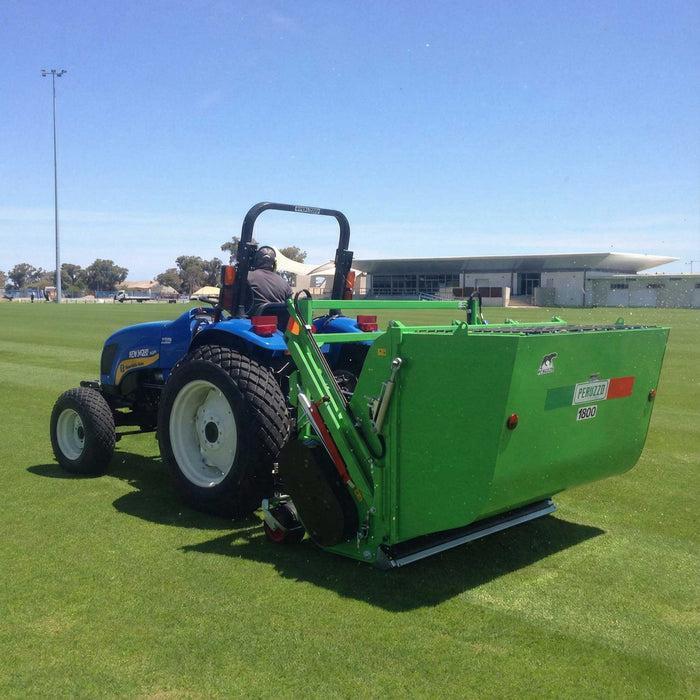
Leaf season turns mowing into a collection job
By mid-September, grounds crews across Canada are planning for the few weeks when leaves come down faster than anyone can rake them. Parks, cemeteries, estates and sports fields all face the same arithmetic, because leaves left lying on turf through a wet autumn smother the grass beneath and leave bare patches by spring. A grass collector mounted behind a tractor lets one pass cut the final growth of the year and lift the leaves with it, and whether it manages that has surprisingly little to do with its blades.
Removing the clippings matters more than the cut
Mowing without collection leaves every clipping on the surface. On a lawn that is often fine, since fine clippings break down quickly, but on longer grass the cut material forms a mat that blocks light, holds moisture against the crown of each plant and slowly builds a layer of thatch.
There is a second effect that matters on roadsides and meadows. Clippings left to rot return their nutrients to the soil, and that steady fertilizing favors a few aggressive grasses over the wildflowers that struggle on poorer ground. Cutting and removing the material does the opposite, gradually lowering fertility and allowing a more varied plant community to establish.
That is why a verge mower that collects is treated as a management tool rather than a tidying machine. What leaves the site is as important as how short the grass ends up, and a machine that simply cuts cannot achieve that outcome no matter how well it performs.
In a flail mower with grass collector, the rotor is also the fan
A flail rotor carries dozens of small knives on a horizontal shaft spinning at high speed. As the knives pass through the grass they cut it, and as they sweep around the housing they push air ahead of them, much as the vanes of a centrifugal fan do.
That airflow is what carries the material. Cut grass is thrown upward, caught in the moving air and driven through a duct into the hopper. In most machines of this type there is no separate blower, so the rotor has to cut and pump air at the same time, and the shape of the knives decides how much of each it does.
Scoop-shaped flails move more air and suit collection, while slimmer knives cut more cleanly but lift less. Some machines also accept scarifying flails that rake moss and thatch out of turf, and the same airflow collects that debris in exactly the same way.
The hopper has to release the air and keep the grass
Air driven into a closed box has nowhere to go, and once pressure builds inside the hopper, the flow through the duct slows and material drops back onto the ground. Every collector therefore has a screen or vented panel that lets air escape while holding the clippings back.
That screen is where most collection failures begin. Fine, damp material presses against the mesh and gradually seals it, which raises the pressure inside and starves the duct of airflow. The operator sees grass falling behind the machine and assumes the hopper is full, when it may be only half loaded behind a blocked screen.
The practical habit is to check the screen each time the hopper is emptied rather than waiting for collection to fail. A grass collector that is losing material with a light hopper almost always has an airflow problem, and brushing the mesh clear restores performance faster than any adjustment to cutting height or ground speed.
Moisture decides whether the grass flies or sticks
Dry clippings are light and travel easily on moving air. Wet clippings carry a film of surface water that makes them noticeably heavier, and they cling to the inside of the duct, where each layer that sticks narrows the passage for the next.
This is why timing matters more than engine power on autumn mornings. Heavy dew on the turf can sharply reduce collection until mid-morning, and working a flail mower with collector through saturated leaves usually ends with a cleared duct rather than a cleared field.
Leaves present the opposite difficulty. Dry leaves travel well but take up enormous volume, so an uncut leaf load fills a hopper within minutes. Flail knives shred them as they pass, and that shredding packs far more material into the same space, which is one reason a flail machine clears leaf litter faster than a sweeper.
Sorting collection systems by what moves the material
Dealers group these machines by working width, which tells you how much ground is covered per hour and nothing about what happens once the grass is cut. Grouping them by the force that carries the material explains why each one suits different conditions.
A rotor airflow machine is mechanically simple and covers a wide range of work, from long grass to leaves to scarified moss. A brush sweeper costs less but cannot cut, and a vacuum unit handles leaves well while doing nothing to the grass underneath.
What a full hopper does to the tractor behind it
A tractor mounted grass collector changes weight as it works. It starts the job empty and finishes carrying a load of wet material well behind the rear axle, which progressively lightens the front wheels and reduces steering control, especially across a slope.
Hoppers that tip hydraulically raise that load high before emptying it, and a high center of gravity on uneven ground is where rollovers begin. Unloading on level ground, with the tractor straight rather than turned, reduces that risk considerably.
Power is divided as well. Some of the power take-off output goes into cutting, and a substantial share goes into moving air, which is why a tractor that runs a plain flail mower comfortably can struggle with a collector of the same width.
Cutting and collecting is becoming a roadside policy
A growing number of municipalities are revising roadside mowing to reduce cutting frequency and remove the material, both to support pollinators and to cut down the thatch that builds up on neglected verges. That shift turns collection from an occasional finishing task into routine work.
Before choosing a grass collector, walk the site on a wet morning and note where material would need to travel, because moisture and slope will set the limits long before cutting width does. TMG Industrial carries flail collector mowers matched to mid-range tractors, and for these machines the tractor’s power take-off rating and its stability with a loaded hopper deserve as much attention as the working width.